


Most websites are built to satisfy Google’s crawlers. But LLMs never crawl. They process language. And that’s exactly where the importance of a new concept called LLM SEO comes in.
In this blog, we will explain how LLMs scan your website and how to optimize your website with LLM SEO.
What is LLM SEO?
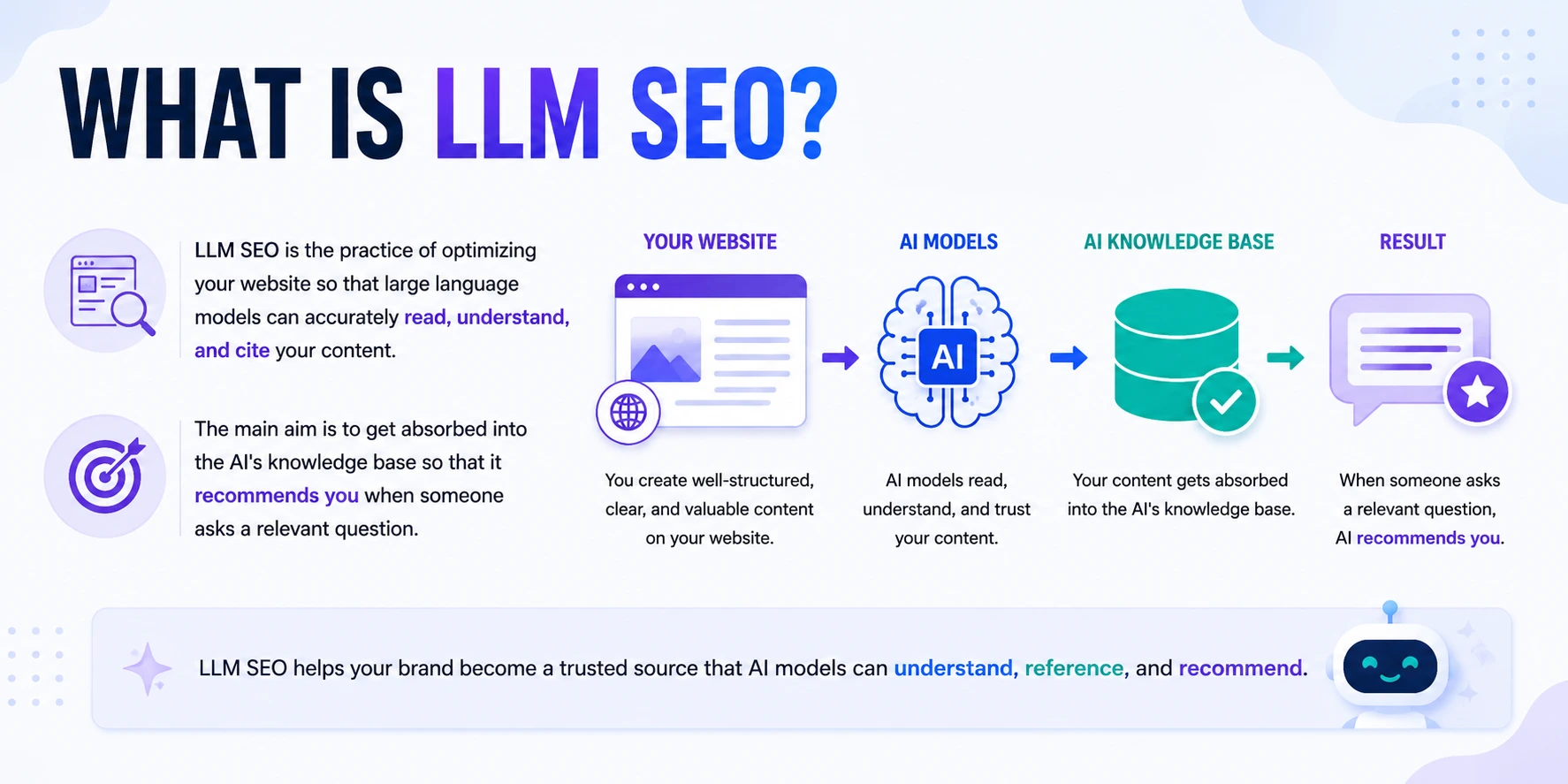
LLM SEO is the practice of optimizing your website so that large language models can accurately read, understand, and cite your content. The main aim is to get absorbed into the AI’s knowledge base so that it recommends you when someone asks a relevant question.
SEO VS LLM SEO: What’s The Difference?
| Factor | LLM SEO | SEO |
| Target | AI-generated answers and citations | Keyword rankings on SERPs |
| Focus | Showing factual accuracy in a structured manner | Raising domain authority through backlinks |
| Optimization | Content structure and semantic depth | Meta tags and page titles |
How An LLM Processes A Page?
Here’s the step-by-step process on how an LLM scans your website:
- Tokenization: Your text is split into about 1-4 character pieces. Unhelpful becomes multiple tokens, not one word.
- Contextual Embedding: Each token is given a number that changes depending on the words around it.
- Attention Layers: The model computes the effect of each token on the meaning of all other tokens in the same passage.
- Semantic Extraction: The last output is a dense description of what the content is about.
Twin Pathways: How LLM SEO Cites Your Website?
Your content is fed to LLMs through two entirely different pipelines:
1. Pre-training Pathway
This is the core knowledge base for models like ChatGPT and Gemini. They consume vast quantities of web content during training. If your site was well-indexed and clearly architected before a model’s training cutoff, your brand is baked into the model’s existing knowledge. It can talk about you without even looking on the web.
2. RAG pathway (Retrieval-Augmented Generation)
This is live retrieval at query time. They are used by Perplexity, by Google AI Overviews, and by the browsing ability of ChatGPT. The model:
- Searches the web in real time
- Retrieves relevant pages
- Generates an answer based on what it finds
This is great, but you need to make your content findable and extractable right now to take advantage of this.
Technical Factors: How AI Views Your Website?
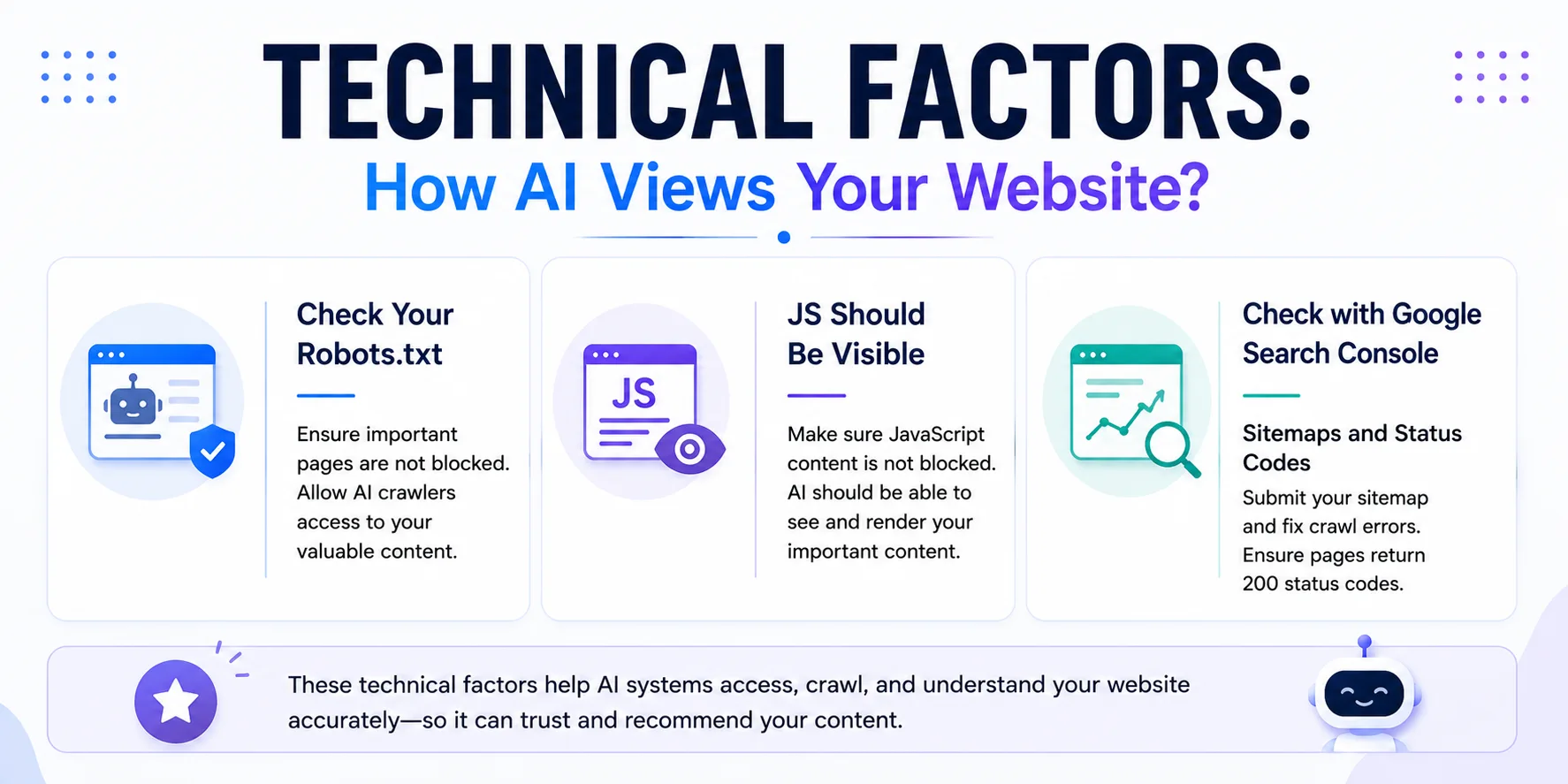
Have a look at technical LLM SEO tips for your website:
1. Check Your Robots.txt
Many sites block AI crawlers without realizing it. The main reasons are:
- Cloudflare’s bot protection settings
- Overly broad robots.txt rules
- Default CMS configurations
Open your robots.txt file and make sure these crawlers are explicitly allowed. It must look like this:
User-agent: GPTBot
Allow: /
User-agent: PerplexityBot
Allow: /
User-agent: Google-Extended
Allow: /
Everything else other than admin dashboards must be open like this.
2. JS Should Be Visible
This one surprises a lot of developers. AI crawlers can only read raw HTML. They do not run JavaScript. This means any dynamic content loaded via JavaScript, content within tabs, accordions, or lazy-loaded sections, or client-side rendered frameworks, is effectively invisible to them.
Here are some solutions to this:
- Move critical content to the server side
- Render JavaScript-heavy pages in advance
And do a quick sanity check: Right-click any important page, and choose View Source. Your main heading, opening paragraph, and key bullet points should be visible in that raw HTML with no JavaScript running. If they’re not, an AI spider can’t see them either.
3. Check with Google Search Console
- Go to GSC
- Select URL Inspection and Test Live URL
- Compare the Rendered HTML Tab with the raw source
Any paragraph that does not make it to the rendered view is a paragraph that no crawler sees. Address rendering gaps before you do anything else.
4. Sitemaps and Status Codes
Keep your XML sitemap updated with timestamps. All important pages should return a clean 200 status code.
On-Page LLM SEO Tips: How LLMs Extract and Trust Your Content?
Once a crawler can get to your page, the next question is whether or not the AI can understand it. These are the signals that decide whether your content gets extracted and cited:
1. Semantic Structure
Have a look at some LLM content optimization tips:
- Write headers as questions
- Begin each section with the direct answer in the first 40-60 words
- Keep paragraphs short and declarative
- Every sentence should be able to stand alone as a fact without the context around it
That last point is vital. AI systems don’t quote full paragraphs. They build an answer by pulling out individual sentences.
2. Schema Markup as Machine-Readable Context
A schema provides the meaning of your content to an LLM. The most important schema types for LLM SEO are:
- Article
- FAQPage
- Organization
- Person
- HowTo
Gemini is in charge of both AI Overviews and AI Mode in the Google ecosystem itself. These models actively capture passages, entities, and structured data to generate answers. Clean schema implementation directly feeds into that process.
3. Clarification of the Entity
Make it clear what your brand does on your website. This context helps LLMs to accurately place your brand in an answer.
4. Depth of Topicality
Cover the whole semantic neighborhood of your subject, including related concepts and subtopics your audience is searching for. AI systems judge whether your site is the most complete source on a topic. Interlinking related pages is also important.
How to Audit Your Site for LLM-Readiness
Here is a practical checklist you can work through today:
- Robots.txt Audit: Make sure that all main AI bots are all allowed.
- Source Check: Open your top 10 pages and check all critical content is in raw HTML
- GSC Render Audit: Use URL Inspection on each key page and compare rendered vs raw HTML
- Schema Validation: Run every important page through Google’s Rich Results Test.
- Bing Index Check: Open Bing Webmaster Tools and check your key pages are indexed
- Manual Citation Test: Search your core topics across ChatGPT, Perplexity, and Gemini. Document what pages get cited
Perform this audit quarterly. AI crawlers change their citing patterns regularly.
We at Growth Vive can conduct a detailed audit and suggest exactly what’s wrong with your website.
Frequently Asked Questions (FAQs)
1. How is LLM SEO different from the traditional SEO I already do?
Traditional SEO is all about ranking for keywords, whereas LLM SEO concentrates on factual accuracy, content structure, and making sure an AI can pull standalone points.
2. Does AI models crawl my website like Google?
Not exactly. Either they learned it in a previous training run, or they pull it live at the moment someone asks a question, through something called retrieval-augmented generation.
3. How does JavaScript affect AI visibility?
Actually, most AI crawlers cannot view JavaScript. If your main text is on a lazy-loaded section that depends on JS, it simply doesn’t exist to the model.
4. What’s the quickest way to check if my site gets cited by AI?
Check your robots.txt file and make sure you are not accidentally blocking bots. Fixing bad security defaults is also equally important, because many kill access.
5. How do models answer questions?
When you type in a complex question, the system usually breaks that question into multiple shorter sub-queries and searches for each one separately. Your content needs to rank for these fragments to appear in the results.
Conclusion
No doubt. Quality of content still matters. But it never guarantees that an AI model can actually cite your site. You need the proper structure for that with clean HTML, open access, schema, and so on. That’s exactly where you need a trusted technical team.
Want to create a content architecture that will work across every major AI platform? Growth Vive does just that. We help brands optimize for the latest LLM citation patterns. Get in touch with us now!