


Your enterprise site has a serious visibility leak, and most SEO audits miss it entirely. AI Overviews now show up in nearly half of all Google searches. According to stats, organic click-through rates for position one have dropped by up to 61% on AI Overview queries.
Position one. Losing over half its traffic. That stings.
Large organizations naturally move slowly. But search behavior does not have patience for that. Every day, your slow adaptation continues, and thousands of indexed pages silently become outdated. Check out exactly why your enterprise must adopt an AI-first search strategy right now.
Why Enterprise Sites Have a Structural AI Visibility Problem?
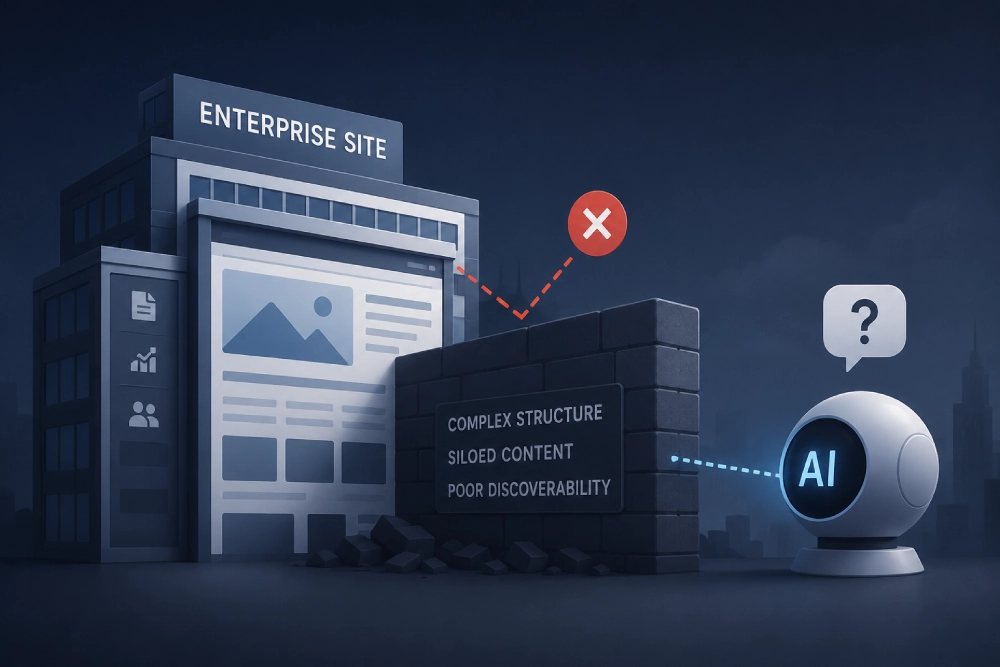
Enterprise websites normally have a big structural issue that most SEO teams ignore. Marketing calls a thing a product, whereas a product page mentions something else. Press releases give a very different third term.
Have a look at the main issue this creates for AI citability:
- For organizations, the challenge is what content is most valuable to surface in AI-generated answers. You need to have clear governance on how and where it appears.
- JavaScript is a barrier. Headless CMS platforms and React single-page applications render much key content client-side. This configuration makes your data completely invisible to AI crawlers.
- Mismanagement of crawl budget destroys visibility at scale.
- AI crawlers operate very differently from the classic Googlebots. Enterprise IT teams block these new bots all the time with tight WAF rules or Cloudflare settings because they don’t understand.
- Content teams may create duplicate or contradictory topic coverage. This may look like a lot of industry experience to the human reader. But AI systems will see this very behavior as low authority.
90-Day Enterprise AI SEO Roadmap: How To Appear in AI Searches?
SEO takes time. But AEO is comparatively quicker. You just need approximately 90 days of hard work to see visible results. Here’s a realistic sequence that enterprise teams can actually execute:
Day 1 to 30: Technical SEO Audit
Fix your technical architecture first. If the machines can’t read your site, nothing else matters.
At Growth Vive, we start the process with:
1. Crawl and Log File Analysis Access
First of all, you must confirm bot access immediately. Check your server logs very carefully to see how exactly OpenAI, Anthropic, and Perplexity crawlers interact with your domain.
Most IT teams block GPTBot by default. Work with your security engineers to whitelist specific AI user agents.
2. Checks for Client-Side Rendering
Find your client-side rendering bottlenecks. You can use a crawler simulation tool to crawl your top commercial pages. Screaming Frog is a good choice as:
- It lets you toggle JavaScript rendering to compare raw server-side HTML directly against the fully rendered DOM.
- It flags specific text that fails to load due to client-side execution errors.
3. Identifying Schema Gaps
These machines have a native tongue called schema markup. Audit your current structured data implementation and check for missing JSON-LD on your core product pages. Concentrate on adding exact Organization, Product, and LocalBusiness schemas.
4. Entity Consistency Audit for Top 100 Pages
Select your top 100 best pages. Check them manually to make sure that product names and core concepts stay the same across all pages. Fix any inconsistencies immediately. You want the AI to recognize a single, undeniable truth about your brand.
Days 31-60: Content Governance and Organization
Standardize how your team creates and handles information through these steps:
1. Note Down Citation-Priority Pages
Don’t try to optimize 5,000 blog posts at once. It’s better to pick the 50 particular pages you want AI to cite most. You can select the most important product comparisons, price breakdowns, technical guides, and any other content that you believe to be cite-worthy.
2. Rephrased Intros for AI Extraction
People love stories, but AI systems need facts. You must rewrite your priority page introductions in accordance with that.
Did You Know?
Intros are boilerplate. 44.2% of all LLM citations come from the first 30% of text!
Try to give a factual answer in the first two sentences to the point.
3. FAQPage Schema Scale Up
Wrap your direct answers in correct schema code. This feeds the machines with accurate Q and A pairs. Even your headings must be written like conversational questions.
4. Upload an llms.txt File
Create a special text file for AI crawlers and upload this to the root of your domain. This file points language models straight to your most authoritative information. It works like an XML sitemap, but built specifically for generative engines.
Days 61-90: Off-Site Distribution and Authority
Solely content is no longer enough. You must also create external signals that confirm your authority. The AI models trust consensus most of all.
1. Media Push
Mentions in the external press are as important as backlinks. So, try to get placements on highly trusted domains such as Forbes, TechCrunch, or niche industry journals.
Did You Know?
Media citations are more important than you think. According to stats, 85.5% of AI citations come from earned media.
2. Community Involvement in Reddit
Be active in the relevant subreddits. Reddit is a huge source of training data for AI models. It’s also the most cited source currently out there across all major generative engines.
You should develop a platform-specific strategy. Just try to answer all related queries with real value.
3. Industry Articles on LinkedIn And Medium
These platforms rank very high in generative search algorithms. So, you must publish structured and data-rich opinions on both, rather than merely copying your website blogs.
4. Press Mentions for Easy Extraction with AI
Change the way you write press releases. Write them with AI extraction in mind. It should have:
- Plenty of bullet points
- Include hard data and clear statistics early in the document.
A good press release is quickly picked up by news-gathering algorithms.
Day 90: Measure Your Progress
You need to measure your progress systematically. Traditional SEO metrics are of no use here. Have a look at what you need to track:
1.Track Citation Count
Track how many times your brand is directly mentioned by major AI engines. Ahrefs, SEMrush, Similar Web, Quilbot, and all major platforms offer free citation tracking tools, which you can use without even signing up.
2. Measure Referral Traffic to Generative AI
Create custom channel groupings in GA4 to segment your referral traffic and see visitors from AI platforms directly. This traffic usually converts at a much higher rate because the AI pre-qualifies the user.
3. Calculate Share of Voice vs. Three Key Competitors
See how your AI visibility stacks up against your top 3 competitors. You can run about fifty core industry prompts through Perplexity and Gemini. Keep a record of who owns the generative answers exactly. Jot down competitor-dominated queries and target them in the next quarter
Frequently Asked Questions (FAQs)
1. Why does AI completely ignore an enterprise website’s technical documentation?
Your documentation is probably behind a login screen. It can also be entirely generated via complex JavaScript. To have AI quote this data, you need to make it server-side available and strip the authentication walls.
2. How to stop your security system from blocking AI crawlers?
You need cross-department alignment. Show your IT team which bot user-agents attract most traffic. Create tight whitelists for OpenAI and Perplexity crawlers, while blocking malicious scraping bots.
3. Is traditional SEO still relevant for large enterprise websites?
Yes. Fast loading time and logical site architecture are still important. AI crawlers still need a healthy website that’s technically sound to discover and process your content efficiently.
4. Can we just recycle our existing blog posts to this AI strategy?
Not without heavy editing. Most enterprise blogs bury the real answer under five paragraphs of corporate storytelling. These should be reworded to be led by hard facts and structured tables.
5. How long does it take for an AI model to update its answers after we make changes?
It depends on the model. Platforms like Perplexity that respond in real-time change citations quickly. Some rely on massive training runs to refresh their internal knowledge graphs over a period of months.
Conclusion
Your competitors are smaller and more agile, and are capitalizing on your slow approval processes. They’re stealing high-value AI citations right under your nose. Don’t lose your hard-fought market position!