


The way people search is no longer the same. Instead of clicking through pages of results, many now turn to tools like Perplexity, Gemini, and ChatGPT to ask direct questions. This change is altering the way brands are found online.
That’s where the idea of GEO (Generative Engine Optimization) comes in. It helps brands appear in AI-generated answers. But how exactly does it work? Let’s check it out.
What is GEO?
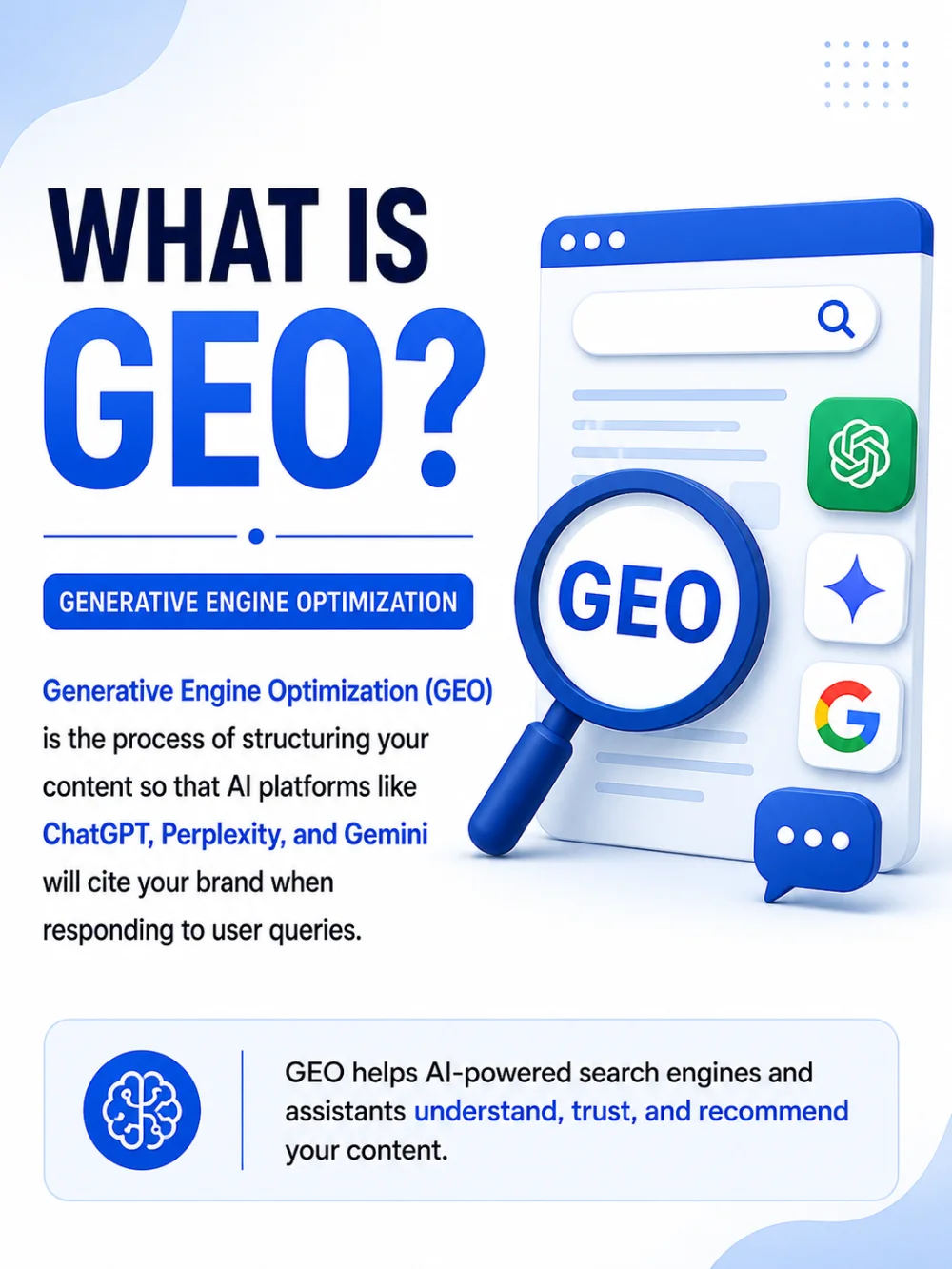
Generative Engine Optimization (GEO) is the process of structuring your content so that AI platforms like ChatGPT, Perplexity, and Gemini will cite your brand when responding to user queries.
Why is GEO Important in 2026?
Have a look at some reasons why it’s the perfect time to set a GEO strategy:
- AI search is no longer the future, but the present, where your audience currently lives. Your audience is asking questions there every day and reading (perhaps even trusting) whatever source the AI recommends.
- Organic traffic from search engines is sharply declining. Brands that don’t have a GEO strategy are at risk of zero traffic.
- Citations are the new backlinks. Every time an AI platform references your brand in an answer, it’s direct exposure to a high-intent user who is looking for information. It develops authority more quickly than most link-building campaigns.
- Most mid-market brands still don’t have a dedicated GEO strategy, which means the first-mover window is still open. But, it’s closing fast.
- Time for GEO compounds. Brands publishing citation-ready content are now building a citation history that AI models will favor in real-time retrieval and future training updates. The longer you wait, the harder it gets to be cited.
What Content Signals Do Perplexity, Gemini, and ChatGPT Use to Select Brand Mentions?
Perplexity, Gemini, and ChatGPT find brand mentions by taking into account source credibility, factual consistency across the web, and how content from a brand’s website answers specific questions clearly. The more frequently a brand is mentioned in authoritative, well-structured sources, the more likely it will be included in an AI-generated answer.
Check out the main signals AI systems use for brand mentions:
1. Source Authority and External Validation
Even though there’s no Domain Authority (DA) weightage, AI systems also verify the authority of a website through:
- Trust in Backlinks: AI models are trained on data skewed towards high authority domains. Claims from external sites like Forbes and G2 have much more weight.
- Consistency in Review: In particular, Gemini pulls from structured review platforms. More frequent surfacing of a brand is achieved through consistent ratings and detailed user language.
- Knowledge Graph Presence: An AI finds it easier to trust a brand entity that is clearly present in structured public databases, like Wikipedia.
2. Structure of the On-Page Content
AI systems always cite content with:
- Question and answer style. Perplexity takes in content that was written to answer a question more reliably and cites live sources.
- Clear brand placement, including what your brand does, who it does it for, and what category it is in. AI needs this context to put your brand in the right spot in an answer.
- Presence of schema markup. Structured data, such as FAQ, Product, and Organization schema, provides machine-readable signals to AI crawlers about your brand’s identity.
Did You Know?
Perplexity references its sources in real time. So if you write well-structured content on an indexable page, it can be quoted verbatim.
3. Factual Accuracy
Make sure that your brand name, category, and core claims are consistent everywhere. Any sort of conflicting information between sources raises confusion, and AI systems may ditch the brand altogether.
4. Conversational Language Match
AI-generated responses are written in natural language. Brands that match the same language users type into prompts are more often cited.
Did You Know?
ChatGPT has been trained primarily on content that breaks concepts down into steps. That same format makes content readable for humans but also extractable for AI.
How To Build Your Brand Authority So AI Engines See You as a Trusted Source?
AI engines refer to brands with a verifiable web presence. They use sources that other credible sites already cite, so your authority is based on what the internet says about you.
Here are some GEO tips to establish that brand authority for your website:
1. Create a Citation Footprint AI Can Verify
AI models cross-check information. When your brand is given consistent coverage across a variety of trusted sources, that consistency becomes proof of legitimacy. Check out how to do that:
- Make sure that your website is mentioned on trusted industry publications, news sites, and niche directories.
- Ensure your NAP (Name, Address, Phone Number) is consistent on all platforms.
- Get backlinks from domains related to the topic. A link from a relevant authority site carries way more weight than ten generic ones
- Have a strong Wikipedia or Wikidata profile. AI models rely heavily on those to assess entity credibility
- Use schema markup. Organization, Author, and Product schema help AI parse exactly who you are and what you do.
2. Produce Content That is Citable
Getting cited by an AI and ranking on Google are two distinct things. AI engines like content that answers the question immediately, has original data, and has clear, quotable statements.
You must:
- Write definitive statements that your industry doesn’t have
- Publish original research, surveys, or proprietary data on a regular basis
- Use headings that match how people ask questions
- Keep your expert author bios detailed and link to outside profiles
- Update older content so that AI models see you as an active source
3. Create a Cross-Platform Presence AI Can See
AI systems never visit your website. They scan the entire web to figure out who you are and if enough credible sources agree with that picture. A brand that only exists on its own domain is effectively invisible to that process.
When your brand exists on multiple independent platforms, you are proving the AI systems that your brand is real, active, and recognized. Here’s how to deliberately build that presence:
• Go to Reddit
Reddit is the #1 source cited for all the major AI engines. And the best part is that you don’t need a single penny to establish footprints on the platform. Just join niche subreddits, answer questions, and let your expertise shine through naturally.
• Medium and LinkedIn Articles
A well-written post on either platform that mentions your brand or links to your site will increase your citation footprint without any technical setup.
• Build a YouTube Presence
Brand names in video descriptions are some of the strongest correlating factors for AI Overview visibility. Even a small channel with good titles and quality transcripts works.
• Earn Press Mentions
A brand mention in Forbes, Business Insider, or an industry publication, even if there’s no link, is an entity signal. AI models parse unlinked brand mentions in training data and live retrieval.
At Growth Vive, we can implement an all-in-one marketing strategy for your brand so that you can focus on what matters the most.
4. Optimize For Each Platform
Most brands are treating Perplexity, ChatGPT, and Gemini as one target. Well, they are not.
The platforms have different ways of pulling information and different types of content they prefer for citation. Have a look at them:
| Platform | What It Prefers | What You Should Do To Get Cited? |
| Perplexity | Preference for freshness and parseability. | Write with short paragraphs, updated timestamps in schema, and direct declarative sentences. |
| Gemini | Solid organic presence on all Google platforms | Create a complete Google Business Profile, an active YouTube channel, and implement Google-indexed structured data |
| ChatGPT | Bing indexation | Index your content in Bing, as its browsing features run on it |
Frequently Asked Questions (FAQs)
Conclusion
AI search is no longer the future. It’s already here, and deciding whether your brand deserves to reach their millions of users. The only question is: Are you prepared for this change?
At Growth Vive, we help brands create GEO strategies to get their brand cited in AI-generated answers. Get in touch with us now for more information!